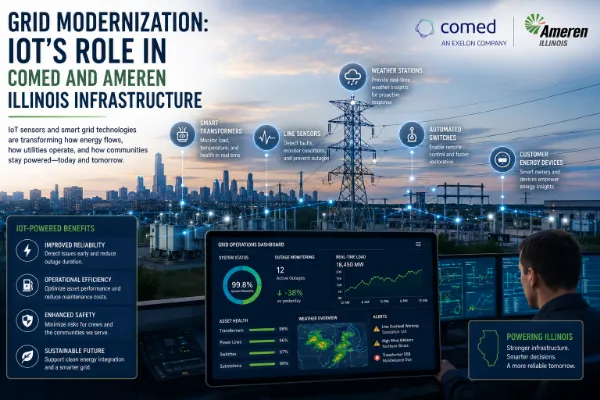
Most coverage of grid modernization focuses on what utilities are doing. This piece asks a different question: where does that spending create openings for everyone else? Illinois passed the Clean and Reliable Grid Affordability Act, known as CRGA, in January 2026, and it took effect on June 1. It turns what used to be a slow planning conversation into a set of deadlines, procurements, and programs that vendors, integrators, and large energy users can actually act on. For anyone working in Smart Utilities, it is the most consequential Illinois policy shift in years. For background on the utilities' own plans, see our earlier piece on grid modernization at ComEd and Ameren Illinois.
Governor Pritzker signed the law on January 8, 2026. Its core provisions create concrete demand for connected hardware and software.
| CRGA Provision | What It Means | IoT Relevance |
|---|
| 3 GW energy storage target by 2030 | Illinois Power Agency procurements in 2027 and 2028, from a base of roughly 200 MW of grid-scale storage today | Battery controls, telemetry, monitoring |
| Utility virtual power plant programs | Utilities must pay customers to dispatch batteries, thermostats, and EV chargers at peak times | Device connectivity, aggregation platforms, metering |
| Grid-enhancing technologies | Utilities directed to adopt tools that squeeze more capacity from existing lines | Line sensors, dynamic line rating |
| State Integrated Resource Plan | More state-level modeling of demand, emissions, and reliability | Data collection, forecasting inputs |
| Higher efficiency goals | Ameren Illinois programs roughly doubled, ComEd programs up about 25 percent | Smart thermostats, building controls, metering |
The fastest-moving piece is the virtual power plant. The Illinois Commerce Commission has approved ComEd's battery-based scheduled dispatch virtual power plant, which replaced an earlier, narrower proposal ComEd withdrew after CRGA passed. Utilities must file broader, multi-faceted VPP proposals by the end of 2027. ComEd reports about 1.8 GW of distributed energy resources already connected to its grid, which shows the base these programs build on.
A virtual power plant is only as good as its connectivity. Every battery, thermostat, and charger that participates needs to report status, accept dispatch commands, and prove delivery through metering. That is a device management and data problem, and it is where integrators and software vendors find work. Our piece on solar and battery optimization against Illinois utility rates covers how customers benefit, while our look at EV charging load management shows how fleets can participate.
Demand is rising faster than supply. PJM, the grid operator covering northern Illinois, reached an instantaneous load of 162.7 GW on July 2, less than 3 GW below its all-time peak from 2006. Data centers are a major driver of new load in the region, a theme explored in our piece on Illinois's data center construction boom. CRGA is partly a response to that pressure: build storage, unlock flexibility, and squeeze more from existing wires while new generation and transmission take years.
- Device connectivity and aggregation. Platforms that enroll, authenticate, and dispatch thousands of small devices reliably.
- Metering and verification. Interval data that proves a battery or thermostat delivered what it promised, since payment depends on it.
- Grid-edge sensing. Line sensors and dynamic line rating can reveal spare capacity on existing lines, with some vendors citing gains of 15 to 40 percent, though actual results vary by line and conditions.
- Commercial and industrial enrollment. Facilities with controllable loads, such as HVAC, refrigeration, and batteries, can earn revenue by participating.
- Cybersecurity. More connected endpoints means more attack surface, which creates demand for segmentation and monitoring expertise, as discussed in our piece on OT cybersecurity for Illinois industrial plants.
Consider a mid-size Illinois integrator that has historically installed building automation for commercial clients. CRGA gives it a new service line: enrolling its existing client base in utility virtual power plant programs. A cold storage operator with controllable refrigeration loads, a manufacturer with a battery system, and an office portfolio with smart HVAC each become dispatchable resources. The integrator handles device connectivity, interval metering, and enrollment paperwork, and shares in the revenue the customers earn. Nothing about the client's core business changes. What changes is that a cost center, electricity demand, becomes a source of income.
Tariff terms, compensation rates, and technical requirements are still being finalized, and the multi-faceted VPP programs are not due until the end of 2027. Businesses should plan for rules that will evolve rather than assume current terms are permanent.
Devices from many manufacturers need to communicate with utility systems through common standards. Choosing hardware that supports open protocols reduces the risk of being locked out of a program later.
Customers need to know their comfort and operations will not be disrupted. Programs that give participants clear override controls and transparent payment tend to hold enrollment better.
Expect storage procurements in 2027 and 2028 to create steady demand for battery monitoring and control systems. Expect utilities to lean on grid-enhancing technologies to delay costly new lines. And expect virtual power plants to expand from batteries to thermostats, EV chargers, and commercial loads as the multi-device programs take shape, turning enrolled devices into a visible, dispatchable part of the grid.
Browse more Smart Utilities coverage, including this companion piece on how data center growth is increasing demand for connected energy monitoring, and the Chicago Smart Utilities hub.
CRGA is an Illinois law signed on January 8, 2026 and effective June 1, 2026. It sets a 3 GW energy storage target by 2030, requires utility virtual power plant programs, and promotes grid-enhancing technologies and expanded efficiency programs.
It is a program that pools distributed resources, such as home and business batteries, smart thermostats, and EV chargers, and pays participants to supply or reduce power during peak demand, so the group acts like a power plant without a physical one.
The Illinois Commerce Commission approved ComEd's battery-based scheduled dispatch virtual power plant, and utilities must file broader multi-faceted VPP proposals by the end of 2027.
Regional demand is approaching record levels, with PJM load reaching 162.7 GW in July, and data centers are adding significant new load, so the state is seeking faster ways to add capacity than building new generation and transmission.
Facilities with controllable loads or batteries may be able to earn compensation for reducing demand at peak times, and integrators and software vendors can build services around enrollment, connectivity, and metering.
They are tools such as line sensors and dynamic line rating that help utilities safely carry more power over existing lines, delaying the need for costly new construction, with results that depend on the specific line and weather conditions.
Frequently asked questions
CRGA is an Illinois law signed on January 8, 2026 and effective June 1, 2026. It sets a 3 GW energy storage target by 2030, requires utility virtual power plant programs, and promotes grid-enhancing technologies and expanded efficiency programs.
It is a program that pools distributed resources, such as home and business batteries, smart thermostats, and EV chargers, and pays participants to supply or reduce power during peak demand, so the group acts like a power plant without a physical one.
The Illinois Commerce Commission approved ComEd's battery-based scheduled dispatch virtual power plant, and utilities must file broader multi-faceted VPP proposals by the end of 2027.
Regional demand is approaching record levels, with PJM load reaching 162.7 GW in July, and data centers are adding significant new load, so the state is seeking faster ways to add capacity than building new generation and transmission.
Facilities with controllable loads or batteries may be able to earn compensation for reducing demand at peak times, and integrators and software vendors can build services around enrollment, connectivity, and metering.
They are tools such as line sensors and dynamic line rating that help utilities safely carry more power over existing lines, delaying the need for costly new construction, with results that depend on the specific line and weather conditions.
Related articles

 Smart Utilities